Download document () of 20
 Send email
Download
You have exceeded the download limit
By Rick Schear, Product Manager, Connectivity and Communications, Eaton Corp. and Chris Loeffler, Data Center Applications Manager, Distributed Power Solutions, Eaton Corp.
As data centers have become a critical component for businesses, their reliability and efficiency has become increasingly more important. Today, as organizations face the challenges of optimizing data center performance, they are recognizing that monitoring power quality and managing energy usage is essential to achieving greater reliability, efficiency and cost effective operation.
With the addition of connectivity and communications tools, data centers can take a quantum leap in their ability to progress from focusing solely on performance to proactively monitoring power and managing energy.
From Performance to Management
Data centers rely on an uninterruptible power supply (UPS), a power supply that includes an internal energy source like a battery, to prevent detrimental aberrations of the power source (outages, sags, surges, harmonics, etc.) from interrupting the functioning of critical equipment. These devices also supply power in the event of a complete power outage and can trigger an automatic and orderly shut down of connected critical equipment if that power failure is extended to the limits of what the battery can supply. However, shutdown of operating systems on information technology equipment does require communications from the UPS system(s) to the connected equipment.
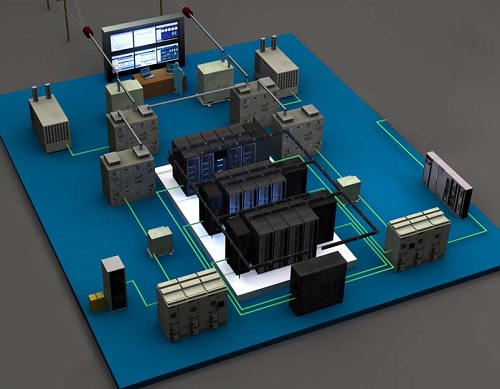 Sample data center floor, using connectivity for online monitoring
Data centers also need a way to distribute the UPS output power to the many devices (servers, storage, networking, etc.) that need to be protected. These devices are known as power distribution units (PDUs), which distribute the electric power to the many circuits located in the typical data center. Data centers rely on PDUs to provide power usage and loading data to easily identify and resolve problems if they should arise. Many PDUs can also monitor environmental conditions such as temperature and humidity, as well as provide logged event histories and reports.
In the past, the emphasis has been on the reliable performance of data centers’ UPSs and PDUs. While both provided data, it needed to be collected by personnel physically going to the units, a time consuming task with associated safety hazards. In addition to those challenges, organizations now face mandates to improve their energy efficiency and clearly need the tools to move from merely focusing on data centers’ power and energy performance to monitoring power quality and managing energy usage, both in real time and historically.
New Tools
The development of connectivity and communications tools like Eaton’s new Power Xpert® Gateway communication cards give data centers the ability to monitor power quality data and energy usage. The cards not only enable data centers to efficiently and cost effectively see the real time status of their power infrastructure without adding software or incurring licensing fees, but also provide a host of historical logging features, for exporting power monitoring and energy management data to Excel or other reports for trending and analysis.
The cards, with their easy to use graphical interfaces, enable users to address individual issues as they occur rather than face the consequences of large scale problems that can result from cascading events. Since the cards provide Web-enabled, real-time monitoring of infrastructure equipment, data centers can quickly respond to power and energy-related events.
 Eaton Power Xpert Gateway UPS card home screen for monitoring a UPS (Eaton BladeUPS shown here)
Additionally, the cards’ open protocol (Modbus TCP/IP and SNMP) enables them to be integrated with existing building management and network management systems.
By adding the card to a UPS users can monitor power quality data from any location with a Web browser. With time-stamped data, event and system logging, users have accurate information for power quality analysis. Intelligent email communication streamlines general event and alarm email notification, and real-time power monitoring enables network managers to view critical device data and make informed decisions. Since data history, event and system logs can be viewed via Web browser, downloaded for review in Excel or emailed to others, sharing data for analysis is simplified.
To monitor energy usage, which can reveal opportunities and verify results of energy improvements, users can insert a communications card into their PDUs. In addition to viewing panel, sub-feed breaker and branch circuit names and settings, the parameters can also be edited to include panel or breaker names, breaker ratings, breaker alarm and warning set points, and percentages. Here again, the Web-enabled solution provides remote monitoring capabilities of real-time data as well as a historical profile of the power distribution system’s energy usage. Network managers can view critical downstream device information, such as status, energy and power quality data as well as remotely configure and edit panel and breaker settings.
Building a Bridge
While UPSs and PDUs are a warehouse of information, the addition of connectivity and communications cards builds a bridge that enables information to be easily accessed, shared and utilized to optimize data centers’ power quality monitoring and energy usage management capabilities.
With the flexibility and features of these Web-enabled tools, users have an efficient, real-time method for communicating with UPSs and PDUs and the units have the ability to alert the users via email when there is a situation that demands attention.
In addition, the cards provide data centers with the ability to achieve their short and long term energy management and energy consumption goals. Communications and connectivity cards provide data centers with a strategic asset by not only eliminating safety concerns and reducing labor costs, but also enhancing data centers’ reliability by constantly monitoring and sharing power quality and energy usage enterprise-wide. With the cards, data centers have the tools to reduce energy consumption, increase dependability and maximize their capital investments.
 Connectivity is the bridge to online monitoring and powerful alarm and logging capabilities in your data center

 MyEatonFAQs


