Download document () of 20
 Send email
Download
You have exceeded the download limit
This webpage outlines our modular approach to future data center design, integrating scalable IT infrastructure, advanced cooling systems, and high-capacity DC power distribution to support AI, HPC, and quantum workloads.
By aligning with emerging standards and emphasizing rapid deployment, energy efficiency, and fault tolerance, Eaton enables resilient, next-generation data hall architectures.
As data centers evolve to support AI workloads, the demand for increasingly high-power, compute-intensive infrastrcuture is reshaping design requirements. This paper presents Eaton’s vision for the future of data center white space and data hall architecture, emphasizing modularity, scalability, and energy efficiency tailored to artificial intelligence (AI) factory output. It explores innovations in direct current (DC) power distribution, including the integration of medium-voltage solid state transformers (MV-SSTs), DC sidecar platforms, Information Technology (IT) module architecture, and advanced cooling systems. Eaton’s vision also outlines emerging standards, safety considerations, and deployment strategies that enable rapid, repeatable, and regionally compliant installations.
Traditional servers typically consume between 10 kW and 50 kW per rack, whereas AI servers require densely packed, high-compute cores to enable fast, low-latency communication. As a result, AI racks exhibit significantly higher power densities, often exceeding 120 kW per rack, with projections reaching 600 kW or even 1 MW per rack in the future. Deploying multiple such systems can lead to the formation of ultra high-power data centers.
Whereas large data centers in the past might have approached 100 MW in capacity, AI factory campuses are scaling to 10 times that size or more, reaching gigawatt-level power demands. To put that in perspective, the combined power consumption of multiple AI campuses is likely to exceed that of many major cities.
This remarkable densification of power, cooling, and compute—combined with large-scale buildouts—calls for a more efficient and scalable approach to high-density data center infrastructure. In other words:
Traditionally, power, IT, and cooling architectures have been developed independently and integrated through standards or custom designs. However, when managing power densities that are 10 to 100 times greater than those of conventional compute environments, a co-designed system architecture becomes critical. This approach enables the infrastructure to effectively support high-density deployments, while the interconnectivity between subsystems forms a unified control layer that governs load management, security, and output optimization.
The increasing power density and parallel processing demands of AI workloads require compute cores to operate with exceptional reliability and availability, surpassing even the standards of today’s best data centers. Industries like automotive and aerospace have shown that high reliability can be achieved through dedicated engineering efforts. To meet these reliability goals at a cost acceptable for modern data centers, production volumes must scale significantly.
Currently, orders of hundreds of transformers or UPS systems are considered substantial. However, a single, integrated medium-to-low voltage power management system, manufactured at volumes of tens-of-thousands, can enable highly optimized, automated production.
This approach delivers high-quality, engineered solutions at competitive prices. Achieving such scale is only possible through modular data center design, where standardized, larger subsystems are developed for high-volume manufacturing.
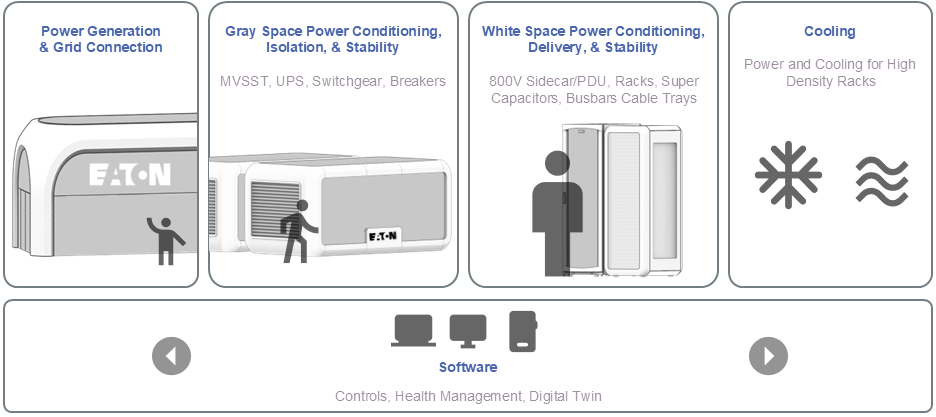
Modular units in a data center can be defined by their physical location or by their technical function. Figure 1 illustrates a power and cooling infrastructure composed of five distinct segments:
1. Block 1 – High-Voltage (HV) Power Generation and Stabilization
This module may include various power generation sources such as gas turbines, solar, wind, or other power plants, as well as grid connections. It delivers medium-voltage (MV) power to Block 2.
2. Block 2 – Medium-Voltage (MV) Electrical Architecture
This block includes switchgear, one or more transformers (solid-state, magnetic core, or hybrid), uninterruptible power supplies (UPS), breakers, and other electrical components. Its role is to convert the MV input from Block 1 into low-voltage (LV) power, which is then distributed to Block 3 via busways.
3. Block 3 – Modular IT Solution
This block receives output (400 Vac, 415 Vac, 480 Vac, 800 Vdc, or ±400 Vdc) from Block 2 and delivers it directly to the IT load, such as servers and networking equipment. Additionally, it will integrate air and liquid-cooling infrastructure at the rack and chip level, along with necessary networking connectivity.
4. Block 4–Cooling Architecture
This block encompasses the entire cooling system, from chip-level thermal management to ambient heat rejection. It can be subdivided into:
5. Block 5 – Communication and Control Layer
This layer enables each subsystem to interface with a centralized compute/control architecture. It monitors subsystem health and can assess the operational status and remaining useful life of individual components.
Eaton leverages digital twin technology and simulation tools during the design and validation of modular infrastructure. These virtual models enable predictive analysis of thermal behavior, power flow, and fault scenarios, ensuring optimal performance and reliability before physical deployment. Digital twins also support building information modeling (BIM) driven coordination and interface control documentation (ICD), enhancing integration across subsystems. By leveraging factory-built modular skids, BIM-driven coordination, and fault-tolerant power systems, Eaton aims to be at the forefront of next-generation data center infrastructure delivering resilient, high-performance environments optimized for future workloads.

Eaton’s IT Module, Figure 2 Block 3, integrates power conversion, liquid and air-cooling systems, containment structures, and rack enclosures to support diverse workloads including HPC, quantum computing, and edge deployments. For current AC distribution, up to 200 racks with densities reaching 200 kW per rack are supported. For future DC input racks, either via DC power sidecar or DC distribution, the IT Module is designed to accommodate 1 MW+ racks. Key components include PDUs, busways, sidecars, HAC, CRAH units, piping and CDUs, sensors, and fire suppression systems. Delivered as a unified SKU, the infrastructure enables rapid deployment and flexible configuration.
Common configurations include:
The higher computing performance that can be achieved by putting as many GPUs as close to each other as possible is driving higher rack power densities and in turn, higher power demands per square meter in the data center. By removing all of the line frequency power conversion from the IT racks, more room is made available for compute and networking. DC-DC power conversion in the rack results in naturally higher DC voltage, which has the advantage of lower currents to distribute to the racks. The ±400 Vdc or 800 Vdc sidecar is an approach to providing voltage to the DC input racks, but it is not the most efficient in terms of power conversion efficiency or white space and row space utilization.
Direct current distribution is essential for next-generation data centers, enabling higher efficiency and compatibility with emerging technologies. Eaton plays a leading role in shaping the DC data center ecosystem by collaborating with customers, suppliers, safety organizations, and initiatives such as Current/OS and the Open Compute Project.
Pow-R-Way III© and PowerWave 2© busway systems currently support scalable ampacity from 225 A to 6250 A at up to 600 Vdc, with short-circuit current ratings up to 85 kA. Eaton’s DC distribution aligns with emerging standards, such as IEC TR 63282 and the Current/OS initiative, which define voltage ranges and power quality requirements for LVDC systems. These Underwriter’s Laboratories (UL) and International Electrotechnical Commission (IEC) certified systems provide safe and flexible deployment for today’s needs. Looking ahead, these platforms are evolving to deliver ampacity of up to 6000 A and voltages of up to 800 Vdc, with future scalability to 1500 Vdc along with short-circuit current ratings up to 200 kA.
Safety features include finger-safe busway channels, branch circuit monitoring, and compliance with evolving NEC standards for DC voltage applications. In order to provide safe, reliable and efficient DC distribution systems, Eaton’s roadmap also includes advanced overcurrent protection devices such as solid-state circuit breakers and hybrid solid state circuit breakers, properly rated for the 800 Vdc ecosystem and 800 Vdc input, 1MW+ IT racks that will populate the datacenters and AI factories of the future.
Medium-voltage solid-state transformer (MV-SST) technology, which delivers compact, high-power solutions for EV fleet charging, data centers, and advanced grid applications. MV-SSTs support both AC and DC configurations—up to 1500 Vdc and 480 Vac—accept input from 15 kV and/or 35 kV class AC systems and occupy only one-third the footprint of traditional systems, significantly reducing installation time and cost.
Additionally, they feature modular architecture with fault isolation and self-healing capabilities, incorporating intelligent power modules (IPMs), redundant switching and cooling systems, and electromechanical bypass mechanisms. These transformers support the integration of multiple energy sources and storage systems, enabling flexible deployment in both indoor and outdoor environments.
Solid-State Power Stations that reimagine substations as active, multifunctional power routers. They enable dynamic control of power flow, voltage regulation, and grid participation. This enhances reliability, resiliency, efficiency, and security through advanced power electronics and multi-level conversion techniques. Together, MV-SSTs and solid-state power stations position Eaton at the forefront of modernizing power infrastructure for electrification and digitalization.
Eaton’s sidecar platform supports up to 900 kW (800 kW nominal) with ±400 Vdc or 800 Vdc output from a 400 Vac, 415 Vac, 480 Vac input. The sidecar can be rapidly deployed to deliver DC power to HPC or AI racks requiring ±400 Vdc or 800 Vdc input in existing data centers with AC distribution. The modular rack architecture includes ten 90 kW power shelves and twelve battery shelves using NMC lithium-ion cells, with optional integration of supercapacitors and solid-state circuit breakers.
The sidecar achieves peak efficiency through intelligent module bypassing and thermal management. Safety features include fast fault interruption, arc flash elimination, and solid-state circuit protection. It supports lithium-ion batteries for improved thermal stability and lifecycle performance. The sidecar enables expansion to higher power levels and voltages (800 Vdc, with future scalability to 1500 Vdc), with dynamic load balancing and control. Minimum Tier III availability (99.982 % uptime), preferably Tier IV availability, is achieved through N+2 redundancy and hot-swappable components.
The development roadmap includes phased validation of PSU, BBU, and PDU components, with full system design verification testing (DVT) by late 2026 and manufacturing readiness by Q1 2027. Eaton is actively seeking industry collaboration to refine and deploy this prototype.
UPS systems that are designed to manage dynamic load profiles, including those associated with AI workloads. These systems offer up to 97.5% efficiency and modularity, with load step capabilities that prevent battery cycling during rapid power fluctuations. When paired with appropriate energy storage devices, a UPS can shape the AI load profile for upstream power infrastructure and the electricity grid. Equipped with the right algorithms, a UPS can leverage connected energy storage such as suitable batteries or supercapacitors, in parallel with the inverter-rectifier power path to smooth out the fast load variations and power bursts typical of AI workloads. This helps prevent adverse grid effects such as voltage fluctuations, flickering, and sub-synchronous oscillations.
Additionally, Eaton’s Energy Aware UPS technology enables data centers to provide grid flexibility and system services, including real-time frequency response. This capability supports increased integration of renewable energy sources. The ability to seamlessly control stored energy can also be used for load management, enabling controlled ramping of data center loads to support grid stability or on-site power generation.
To mitigate risks associated with the growing share of electronic loads on the grid, new regulations are being introduced globally. Eaton’s power conversion solutions are designed to meet these evolving requirements, ensuring data center compliance with connection rules, and preventing adverse impacts on the wider power system.
Modular IT spaces benefit from scalable voltage bands (350 Vdc to 800 Vdc, with future scalability to 1500 Vdc) and fault-tolerant busway architectures. Liquid cooling systems include cold plates, CRAC/CRAH units, and piping infrastructure tailored to workload intensity. DC power busways support up to 2.5 MW of delivery with multiple independent channels. Tap boxes, receptacles, and monitoring systems ensure reliability and scalability.
These modular IT spaces support configurations of 8 to 24 racks. BIM-driven design and digital twin simulation ensure functionality and capture optimization opportunities. Global compliance and partner integration enable repeatable delivery across regions. Eaton’s modular skids and sidecars streamline deployment and enhance operational readiness.
To meet the evolving cooling demands of high-density compute environments, Eaton’s modular cooling skids integrate hot aisle containment (HAC), advanced liquid cooling systems, and intelligent control mechanisms into pre-engineered, factory-built modules. These skids are designed for rapid deployment, regional compliance, and seamless integration with facility infrastructure, supported by BIM-driven coordination for clash-free execution.
Liquid cooling systems include direct-to-chip (D2C) cold plates, Coolant Distribution Units (CDUs), Rear Door Heat Exchangers (RDHx), and tailored piping infrastructure. These components enable efficient heat capture and transfer from chip to ambient, supporting workloads from conventional IT to AI and quantum computing. Eaton’s Block 4 Technological Cooling System (TCS) architecture, Figure 2 Block 4 TCS, supports both hybrid and fully liquid-cooled environments, with up to 200 racks and densities reaching 200 kW per rack. The system is compatible with immersion cooling, flooded chassis designs, and sodium-ion battery integration.
Digital twin simulations complement mock-up validation by enabling virtual testing of coolant flow rates, thermal resistance, and system response under varying load conditions. These simulations optimize skid design for specific workloads and regional climate profiles, reducing deployment risk and improving energy efficiency.
To ensure reliability and performance, Eaton emphasizes mock-up validation, customer QA alignment, and rigorous interface control documentation (ICD). These processes define mechanical, electrical, and software integration parameters—such as coolant flow rates, pressure head, thermal resistance, and DCIM compatibility—ensuring each solution is optimized for production, transportation, and site installation. Modular skids support minimum Tier III availability (99.982 % uptime), preferably Tier IV, and are engineered to prevent failure modes that could compromise IT equipment.
Eaton’s modular cooling strategy enhances scalability and energy efficiency while enabling strategic differentiation through open IT architecture, sustainability features, and cost-effective deployment models tailored to regional climate conditions and water availability.
The transition to higher-voltage DC systems—such as 800 Vdc and beyond—is reshaping the safety, compliance, and interoperability landscape for data centers. Standards from organizations like the International Electrotechnical Commission (IEC), National Fire Protection Association (NFPA), and Underwriters Laboratories (UL) recognize the need for safe deployment of high-density, modular infrastructure by including these higher DC voltages as part of their product standards.
IEC, for example, includes these higher DC voltages as part of the standards they publish governing equipment used in data center applications. Relevant standards include:
UL has also developed several key standards relevant to data center environments:
Compliance with these standards is essential for achieving certification, reducing liability, and ensuring safe operation across diverse deployment environments. Eaton’s modular systems are designed to meet or exceed these requirements, supporting global market access and alignment with authorities having jurisdiction (AHJs).
The future of data center design is being defined by the convergence of ultra-high-density compute workloads, modular infrastructure, and advanced power and cooling technologies. Eaton embraces this transformation through a systems-level approach that integrates scalable IT modules, fault-tolerant DC power distribution, and factory-built skids; all engineered for rapid deployment, regional compliance, and operational resilience. This vision is further strengthened by the use of digital twin simulation during design and development, allowing predictive modeling, performance validation, and optimization of modular systems before deployment.
As AI, HPC, and quantum computing workloads push rack densities toward and beyond 1 MW, traditional design paradigms must evolve. Eaton’s modular strategy enables this evolution by shifting complexity from the field to the factory, improving quality, safety, and speed of deployment. The use of MV-SSTs, sidecars, and intelligent UPS systems ensures that power infrastructure is not only efficient but also adaptive to dynamic load profiles and grid interaction.
Compliance with emerging global standards, including IEC 60947-2, IEC 62477 series, and UL 2755, positions Eaton’s solutions for broad market access and alignment with AHJs. These standards support safe deployment of higher voltage DC systems and modular architectures, enabling scalable, repeatable builds across diverse geographies.
Ultimately, Eaton’s integrated approach delivers a resilient, future-ready foundation for next-generation data halls—one that supports the exponential growth of compute demand while enabling sustainability, fault tolerance, and strategic differentiation.

 MyEatonFAQs


